
Basilosaurus
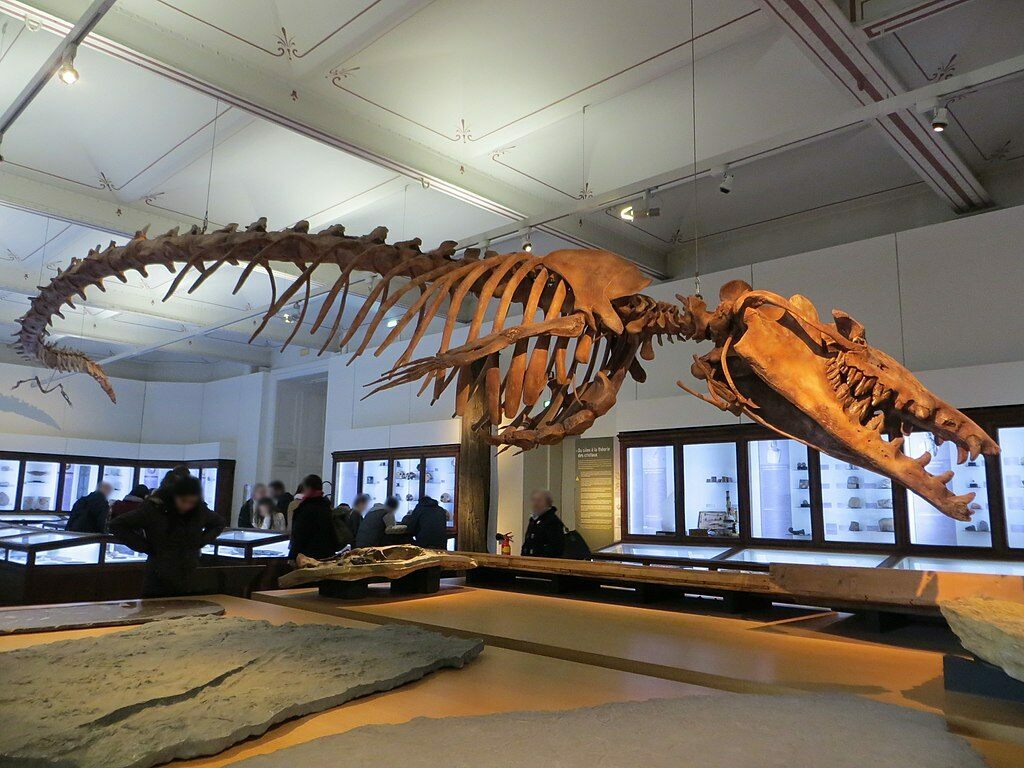

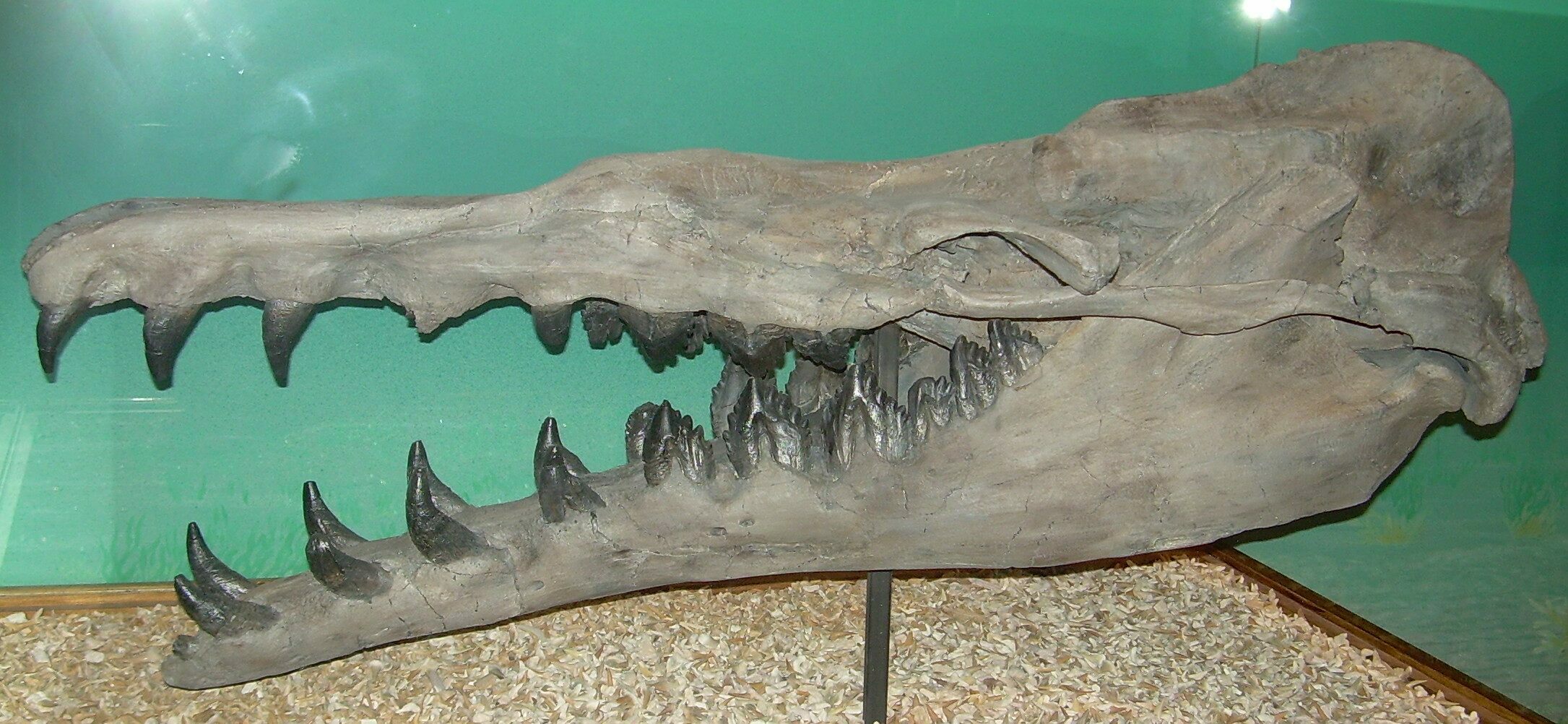
Here’s a detailed overview of Basilosaurus — an extraordinary ancient whale-like creature.
(As always: for general knowledge only, not anything medical or practical.)
-
Despite the name meaning “king lizard” (from Greek basileus = king + sauros = lizard), it was not a reptile but a fully aquatic mammal. The mis-naming happened because early fossil discoverers initially thought it was a marine reptile. (Wikipedia)
-
It belonged to the family Basilosauridae, which are a group of stem whales (pre-modern whales) and among the first fully aquatic cetaceans. (Wikipedia)
Physical characteristics & size
-
Some species reached very large sizes: for example, Basilosaurus cetoides (one of the best known) measured around 17-20 m (55-65 ft) in length and possibly weighed up to ~15 metric tons in one estimate. (Wikipedia)
-
Its body was unusually elongated (serpentine) compared to modern whales: the vertebrae, especially in the posterior thoracic / lumbar / anterior caudal region, were greatly stretched. (Wikipedia)
-
Unlike modern whales, it had heterodont dentition — different types of teeth (canines, molars) used for grabbing and chewing prey, rather than just swallowing whole. (New York Tech)
-
It still retained small hind-limbs (vestigial) — evidence of its land-mammal ancestry — though these limbs were not useful for walking. (Wikipedia)
Ecology & locomotion
-
Habitat: It inhabited warm shallow seas and inland seas during the Eocene. Fossils have been found in locations such as the southeastern United States (Alabama, Louisiana) and North Africa/Egypt (Wadi al-Hitan) indicating wide distribution. (encyclopediaofalabama.org)
-
Feeding: Basilosaurus was likely a top predator of its time, feeding on large fish, sharks, and smaller marine mammals. For instance, stomach contents of B. cetoides show fish bones. (New York Tech)
-
Swimming style: Because of its long, snake-like body and vertebral structure, it may have swum with an undulating motion (anguilliform) near the surface, rather than the strong tail-fluke driven swimming of modern whales. (Wikipedia)
Evolutionary significance
-
As an archaeocete, Basilosaurus represents an important stage in whale evolution: one of the early fully aquatic mammals bridging more terrestrial ancestors and modern whales. (FossilEra)
-
The mix of features (vestigial limbs, elongated body, heterodont teeth) shows how whales transitioned from land to sea and how many unusual anatomical features existed in that journey.
-
Its existence shows that by the Late Eocene, large aquatic mammals had already evolved to fill oceanic predator niches.
Fossil & historical notes
-
The type species B. cetoides was first described in 1834/1839 from fossils in the United States. (Wikipedia)
-
The fossils were once so common in parts of Alabama that vertebrae were used as furniture! (Interesting historical side-note.) (encyclopediaofalabama.org)
-
Because of the initial misidentification as a reptile, the name “–saurus” remained even though it’s clearly a mammal. Zoological naming rules locked in the original name. (Wikipedia)
Why Basilosaurus matters
-
It gives us direct insight into the marine ecosystems of the Eocene, especially predator-prey relationships in ancient seas.
-
It helps us understand the anatomical transformations from land-living mammals to the streamlined modern whales (e.g., limb loss, body elongation, tooth changes).
-
Its fossils are often spectacular (large skeletons, good preservation), making it a “showcase” fossil for evolutionary studies and public interest.
If you like, I can pull up detailed species comparisons (e.g., B. cetoides vs B. isis), or a deep dive on the fossil sites (e.g., Wadi al-Hitan in Egypt) for Basilosaurus. Would you prefer that?

"This Content Sponsored by SBO Digital Marketing.
Mobile-Based Part-Time Job Opportunity by SBO!
Earn money online by doing simple content publishing and sharing tasks. Here's how:
- Job Type: Mobile-based part-time work
- Work Involves:
- Content publishing
- Content sharing on social media
- Time Required: As little as 1 hour a day
- Earnings: ₹300 or more daily
- Requirements:
- Active Facebook and Instagram account
- Basic knowledge of using mobile and social media
For more details:
WhatsApp your Name and Qualification to 9943990669
a.Online Part Time Jobs from Home
b.Work from Home Jobs Without Investment
c.Freelance Jobs Online for Students
d.Mobile Based Online Jobs
e.Daily Payment Online Jobs
Keyword & Tag: #OnlinePartTimeJob #WorkFromHome #EarnMoneyOnline #PartTimeJob #jobs #jobalerts #withoutinvestmentjob"


No comments:
Post a Comment